A systems-level guide to how neural signals, physiology, and habits interact.
Word Count: 2343 | Reading Time: 12 minutes | Last Updated: 11 March, 2026
Why This Matters
For much of modern medicine, mental and physical health have been treated as separate domains. Modern neuroscience now shows this separation to be artificial. The brain and body operate as a single adaptive regulatory system.
Thoughts, emotions, habits, and physical states are not merely connected. They are expressions of the same biological process.
The brain does not sit above the body issuing commands. It is embedded within it, continuously shaped by neural signals, hormones, immune activity, and daily behavior.
The mind–body connection is not a metaphor. It is measurable biology.
Understanding this changes how we think about stress, habits, performance, and long-term health. Sustainable change does not begin with motivation or willpower. It begins with regulation.
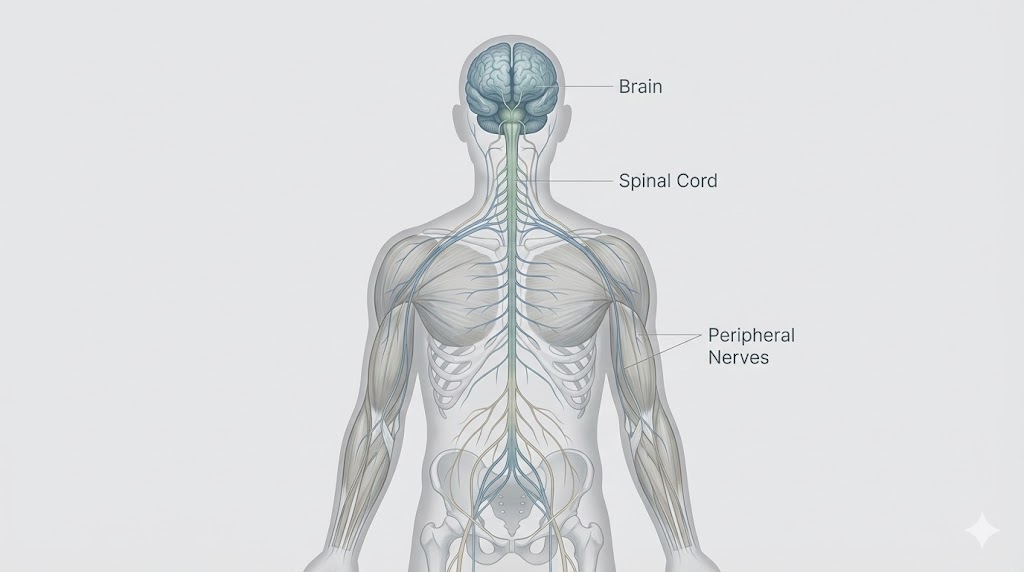
The Brain–Body System: Integration by Design
Recent neuroscience research identified the Somato-Cognitive Action Network (SCAN), linking movement, cognition, and autonomic regulation.
This explains everyday experiences:
- Anxiety creates physical restlessness
- Movement clears mental fog
- Breathing influences emotional state
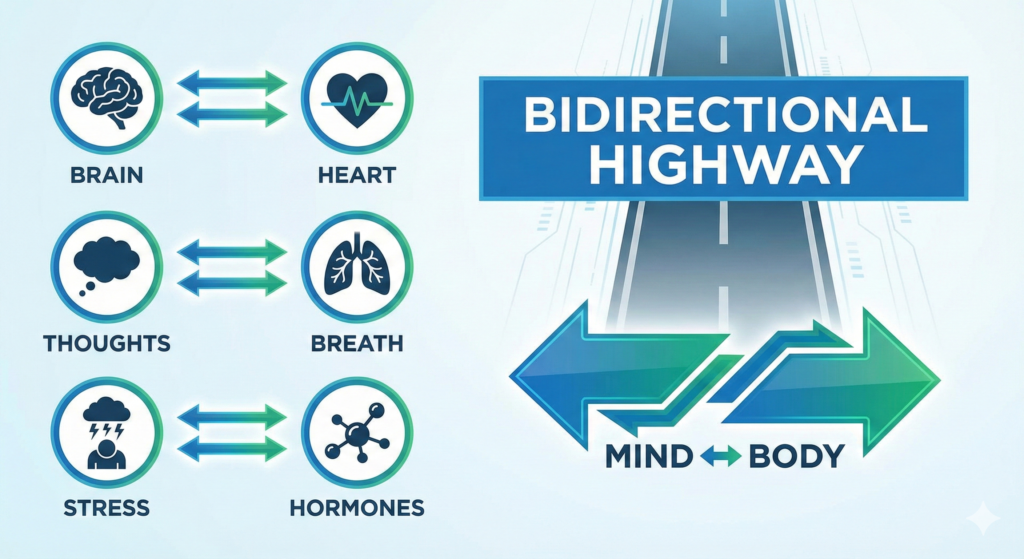
The brain and body continuously regulate each other through:
- neural signaling
- hormonal feedback
- immune communication
Stress is therefore not psychological alone. It is systemic.
Regulation vs Optimization
Most behavior advice focuses on optimization:
do more, improve faster, push harder.
But optimization amplifies instability when regulation is weak.
Regulation means creating a predictable internal environment where attention, energy, and emotion become stable enough for change to occur naturally.
Calm is not the reward for change.
It is the condition that allows change.

Why Regulation Comes Before Optimization
When the nervous system is dysregulated, behavior defaults to short-term survival responses.
This explains why habits fail despite knowledge or motivation.
Regulation stabilizes:
- attention
- emotional control
- energy availability
Intensity produces short bursts of change. Regulation allows change to persist without constant effort.
The Structure Behind Sustainable Change
Most approaches to change begin with motivation, discipline, or identity. Modern neuroscience suggests the process usually works in the opposite direction.
Change tends to emerge through a layered biological process:
Regulation → Biology → Cognition → Behavior → Identity
When the nervous system becomes more regulated, physiological signals stabilize. Stable biology supports clearer thinking and emotional balance. Clearer cognition makes consistent behavior easier, and repeated behavior gradually reshapes identity over time.
Rather than forcing change from the top down, Mind-Body Blueprints approaches change from the inside outward, beginning with regulation.
Change becomes sustainable when these layers align instead of being forced.
The Mind-Body Blueprints Framework
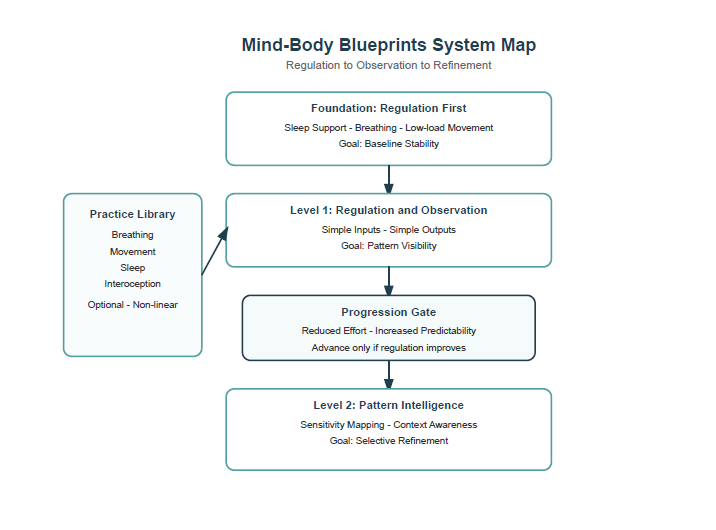
Mind-Body Blueprints approaches change as a system:
- Foundations — explain regulation
- Protocols — influence inputs safely
- Applications — real-world adaptation
- Trackers — observation and feedback
This article serves as the conceptual anchor for the entire system.
The System at a Glance
Observation Before Change
Understanding alone does not change biology.
Before attempting optimization, it is necessary to observe how regulation already operates.
Tracking is not performance measurement.
It is signal detection.
You are not measuring success.
You are noticing patterns.
Practices (Inputs) That Influence Regulation
The following practices are not presented as shortcuts or universal solutions. They are inputs that interact with the brain–body system through identifiable physiological and neural pathways. Their effects depend on consistency, individual context, and baseline regulation. Rather than aiming for intensity or rapid change, these practices are most effective when approached as signals that gradually shape nervous system behavior over time.
1. Conscious Breathing (5–10 minutes)
Breathing is one of the few physiological processes that can be influenced both voluntarily and automatically, making it a direct point of interaction with the nervous system. Slower, controlled breathing patterns alter carbon dioxide tolerance, vagal signaling, and brainstem activity involved in autonomic regulation. Deep, diaphragmatic breathing activates your parasympathetic nervous system, signaling safety to your brain.
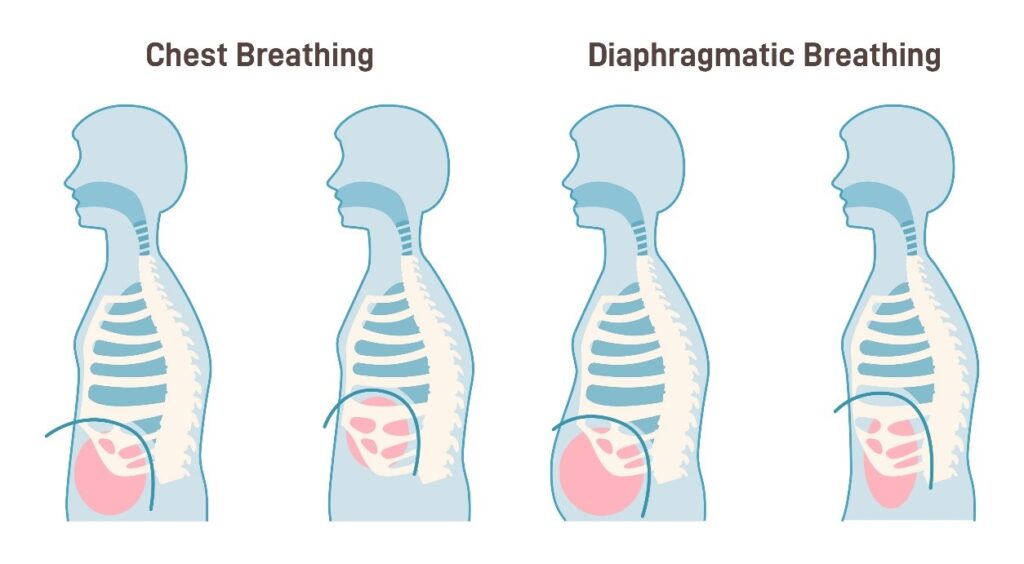
Practice
- Sit comfortably with minimal distraction
- Inhale through the nose for 4 counts
- Pause briefly
- Exhale through the nose for 6 counts
- Continue for 5–10 minutes
Mechanism
Extended exhalation increases parasympathetic influence and is associated with improvements in heart rate variability, a marker of autonomic flexibility. With repetition, this pattern may support improved emotional regulation and stress recovery.
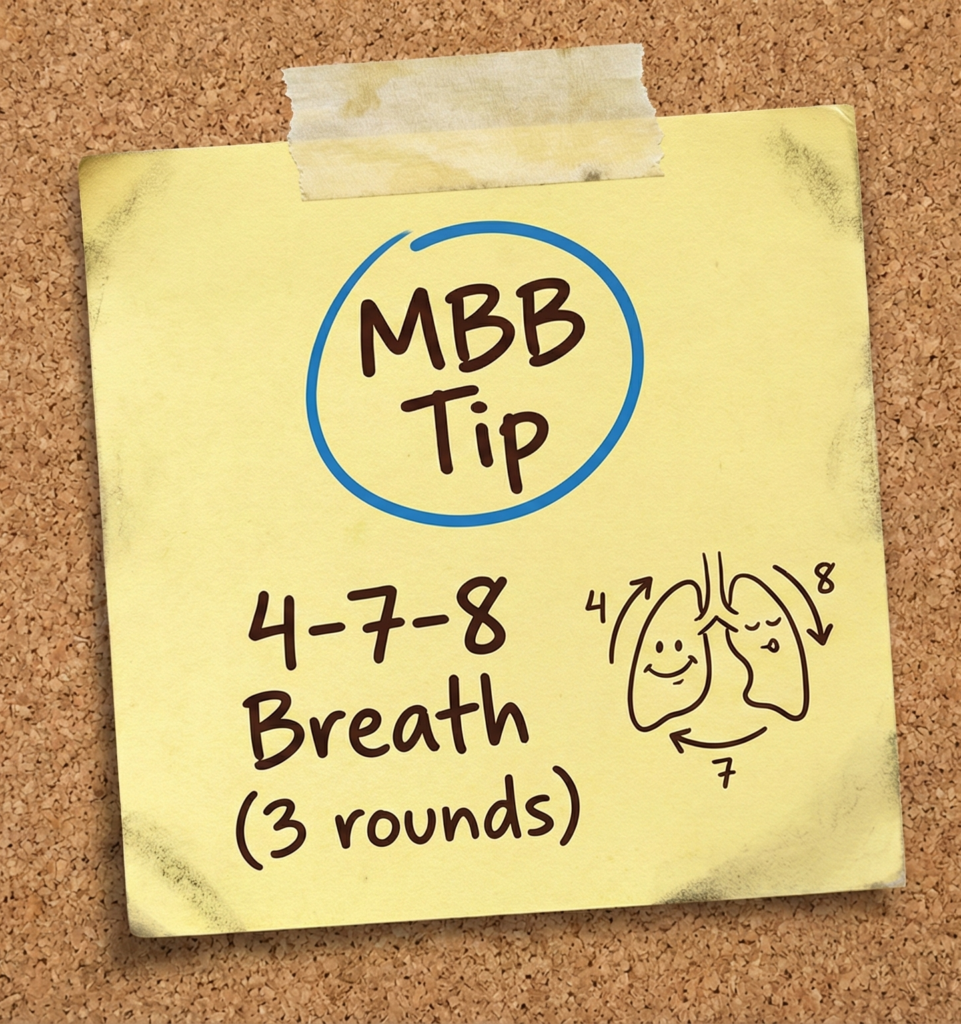
💡 MBB Tip: The Pattern Interrupt Breath
When you notice stress building, use the 4-7-8 technique: inhale for 4 counts, hold for 7, exhale for 8. Repeat 3-4 times. This immediately shifts your nervous system from fight-or-flight to rest-and-digest mode.
The extended exhale activates your Vagus nerve, triggering your parasympathetic nervous system. This is practical neuroplasticity in action—you’re training your brain to default to calm.
2. Movement as Neural Input (20–40 minutes)
Movement is not only mechanical output; it is sensory input to the brain. Muscular contraction, joint movement, balance, and spatial orientation continuously inform neural networks involved in mood, attention, and bodily awareness.
Examples
- Walking
- Gentle yoga or stretching
- Resistance training
- Dance or coordinated movement
- Tai Chi or Qigong
Mechanism
Regular movement influences neurotransmitter availability, cerebral blood flow, and inflammatory signaling. The most effective form of movement is one that can be repeated consistently without excessive physiological strain.
💡 MBB Tip: The Morning Movement Ritual
Start your day with just 10 minutes of movement before checking your phone. This could be stretching, walking, or light yoga. The key is moving before consuming information.
Morning movement primes your brain for optimal function throughout the day by increasing blood flow to the prefrontal cortex and releasing beneficial neurotransmitters like dopamine and serotonin.
3. Mindful Eating and Interoceptive Awareness
Eating provides continuous feedback to the brain through the digestive system, vagal pathways, and metabolic signaling. Attention during meals alters how these signals are processed and integrated.
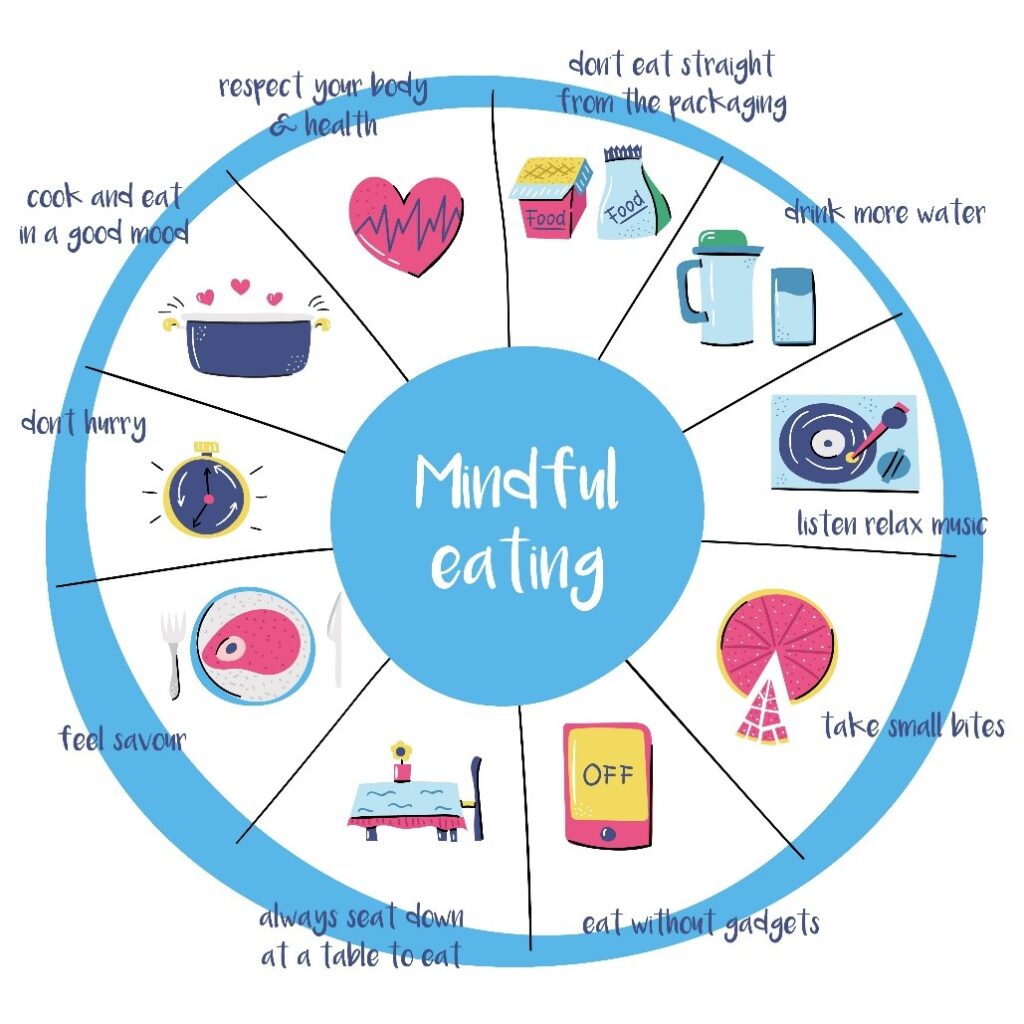
Practice
- Eat without screens or multitasking
- Chew slowly and deliberately
- Pause between bites
- Notice internal sensations of hunger and fullness
Mechanism
Mindful eating enhances interoception, the brain’s ability to perceive internal bodily states. Improved interoceptive accuracy is associated with better appetite regulation, digestion, and emotional awareness.
4. Sleep as a Regulatory Foundation (7–9 hours)
Sleep is a primary regulatory process through which neural networks are recalibrated and physiological systems recover. Disrupted sleep amplifies stress reactivity and impairs emotional and cognitive control.

Foundational conditions
- Consistent sleep and wake times
- Reduced light exposure before bed
- A cool, dark, quiet sleep environment
- Morning light exposure
Mechanism
Adequate sleep supports hypothalamic–pituitary–adrenal axis stability, memory consolidation, and immune regulation. Improvements in sleep often precede improvements in other behavioral domains.
💡 MBB Tip: The Sunset Wind-Down
Create a 60-minute pre-sleep ritual: dim lights, avoid screens, practice gentle stretching or breathing exercises. Your brain responds to environmental cues, and this ritual signals it’s time to prepare for sleep.
Dimming lights increases melatonin production, while avoiding blue light prevents melatonin suppression. The consistent routine strengthens your circadian rhythm.
5. Gratitude Journaling (5 minutes)
Emotional states influence physiological regulation through neural and hormonal pathways. Gratitude practices function as structured attention exercises rather than positive thinking techniques.

Practice
- Write three specific experiences from the day
- Include why each was meaningful
- Observe emotional and bodily responses while writing
Mechanism
Repeated engagement with specific positive emotional content is associated with changes in neural activity within regions involved in emotional regulation. Over time, this may reduce baseline stress reactivity.
💡 MBB Tip: The Specificity Advantage
Instead of writing “I’m grateful for my family,” write “I’m grateful my daughter laughed at my joke today because it reminded me why connection matters.” Specific gratitude activates stronger neural responses.
Detailed emotional memories engage more neural networks than vague positive statements, creating deeper neural pathways and stronger emotional regulation over time.
6. Brief Cold Exposure (30–120 seconds)
Cold exposure acts as a controlled physiological stressor that activates multiple regulatory systems simultaneously.

Practice
- End a shower with 30-120 seconds cold water exposure
- Start gradually (lukewarm to cool)
- Focus on deep breathing during exposure
- Notice the mental clarity afterward
- Maintain steady breathing
- Increase duration gradually
Mechanism
Cold exposure increases norepinephrine release and activates thermoregulatory pathways. When applied conservatively, it may improve stress tolerance and alertness without chronic overload.
7. Nature Exposure and Sensory Downshifting (15+ minutes)
Natural environments provide sensory input that differs significantly from built environments, particularly in visual complexity, sound patterns, and light exposure.

Practice
- Walk outdoors without headphones
- Sit near water or vegetation
- Engage attention with natural sensory cues
Mechanism
Nature exposure is associated with reduced cortisol levels, lower blood pressure, and increased parasympathetic activity. These effects appear to be mediated by reductions in cognitive load and attentional demand.
Individually, these practices exert modest effects. Collectively and consistently applied, they influence the regulatory tone of the brain–body system, creating conditions under which sustainable behavioral change becomes more likely.
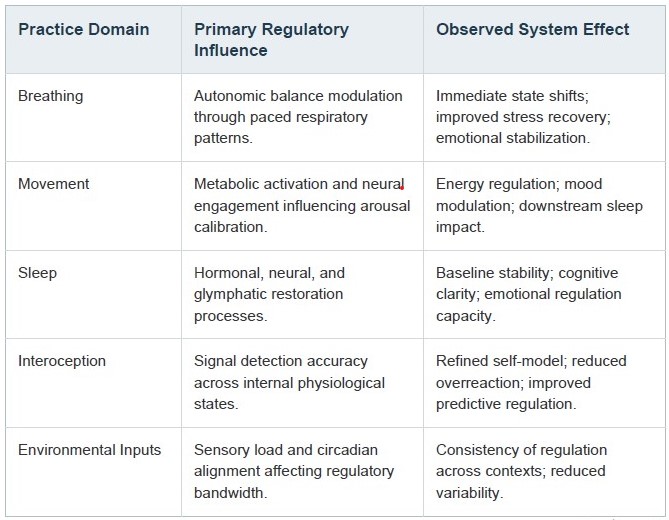
Each practice influences regulation through different biological pathways. The table below summarizes how these inputs affect the system and what changes are typically observed over time.
Move From Understanding to Measurement
Understanding the mind–body connection is the first step.
Observing your own regulation patterns over time is the next.
To support this, you can use the Mind-Body Blueprints Regulation & Observation Tracker. It is designed to help you notice patterns of stress, recovery, habits, and nervous system responses without forcing change.
This tool focuses on awareness and feedback, not optimization or performance.
This tracker is provided as a practical companion to the Foundations article. It can be used independently and adapted to your own context.
A 14-Day Regulation & Observation Framework
This period is designed to establish awareness, not transformation.
Days 1–7: Baseline Stabilization
- breathing practice
- gentle movement
- consistent sleep timing
Observe without judgment.
Days 8–14: Pattern Recognition
Add one additional practice while maintaining baseline behaviors.
Watch interaction effects rather than outcomes.
How to Use the Tracker
- Record briefly each day
- Track at roughly the same time
- Change one variable at a time
- Missed days are information, not failure
This tracker works best as a mirror, not a motivator.
Download the Mind-Body Blueprints Regulation & Observation Tracker
This tracker helps translate understanding into observation by revealing how daily behaviors interact with energy, mood, and regulation over time.
Reflection After 14 Days
Review patterns rather than results:
- What stabilized your system?
- What felt effortful?
- How did sleep influence other variables?
Progress comes from clarity, not intensity.

Closing Principle
Sustainable change begins by understanding how regulation already operates before attempting to direct it.
Small stabilizing inputs, repeated consistently, reshape biology over time. Stability allows change to emerge naturally.
The goal is not optimization. It is coherence.
A Different Way to Think About Change
Much of the advice surrounding health and productivity begins with the assumption that we need to push harder, optimize faster, or add more habits to our routines. The brain–body system rarely works that way.
Before meaningful change occurs, the system usually needs stability. And before stability can be created, the patterns influencing it need to be understood.
Small, repeatable inputs often shape regulation far more reliably than dramatic interventions. When these inputs are observed consistently across several days, the interactions between sleep, movement, breathing, attention, and environment begin to reveal themselves.
Once those patterns become visible, improvement stops feeling like guesswork. It becomes a process of adjusting the system gradually rather than forcing it.
The goal of the Mind-Body Blueprints framework is not to optimize every behavior. It is to make the underlying patterns clear enough that stable regulation becomes easier to support.
Before You Optimize, Observe.
If you understood this framework, the next step is not intensity. It is measurement.
The 14-Day Regulation & Observation Tracker is designed to help you examine your baseline physiology across two weeks.
You will track:
• Nervous system stability
• Stress reactivity patterns
• Energy fluctuations
• Sleep consistency
• Protocol compliance
This is not a productivity challenge.
It is a diagnostic phase.
If you have not implemented the Quick Starter Kit for at least three consecutive days, begin there first.
Observation precedes transformation.
If You Would Like to Explore This Further
The concepts in this article become much clearer when they are observed directly.
The Mind-Body Blueprints 14-Day Regulation & Observation Tracker provides a simple structure for recording a few daily inputs and noticing how they influence energy, mood, and mental clarity across time.
Download the tracker below if you would like to experiment with the framework in your own routine.
Start today. Start small. Start now. This is how you STABILIZE YOUR BIOLOGY and REWIRE YOUR PATTERNS .
References & Further Reading
These references focus on underlying physiological and neural mechanisms rather than specific techniques, consistent with the system-based approach of this article.
- Gordon, E.M., et al. (2023). “Mind-body connection is built into brain.” Nature. Washington University School of Medicine. Read the full study
- Vanutelli, M.E., Hommel, B., & Cancer, A. (2024). “Moving the mind, thinking the body: new insights on the mind-body connection.” Frontiers in Human Neuroscience. Access article
- “The impact of mind-body exercise on quality of life in older adults.” (2024). Frontiers in Public Health. View research
- “What Science Says About the Mind-Body Connection for Better Health.” (2024). Integrative Behavioral Health. Read more
- “World Health Day: The Mind-Body-Health Connection.” (2025). American Psychological Foundation. Explore the connection
- “The Mind-Body Connection: Understanding Their Link.” (2025). Positive Psychology. Read full article
- “Stress Awareness Month 2024.” The Stress Management Society. Access report
- “The interplay of stress, health, and well-being.” (2024). Frontiers in Psychology. View study
- “Mind-body connection: Ancient wisdom meets modern science.” (2024). Mayo Clinic Press. Learn more
- “Stress Management.” (2023). StatPearls, NCBI Bookshelf. Clinical resource
Disclaimer
This article is intended for educational purposes only and does not constitute medical advice. The Mind-Body Blueprints framework focuses on observing how daily inputs may influence energy, mood, and regulation. Individual responses may vary. If you have a medical condition or specific concerns, consult a qualified healthcare professional before making changes to your routine.
Thankk-you so much for providing very interesting insight about mind-body connection. I will definitely try the 14 Day tracker.