
How Respiratory Patterns Influence Neural State and Autonomic Stability
Word Count: 2702 | Reading Time: 14 minutes | Last Updated: 23 April, 2026
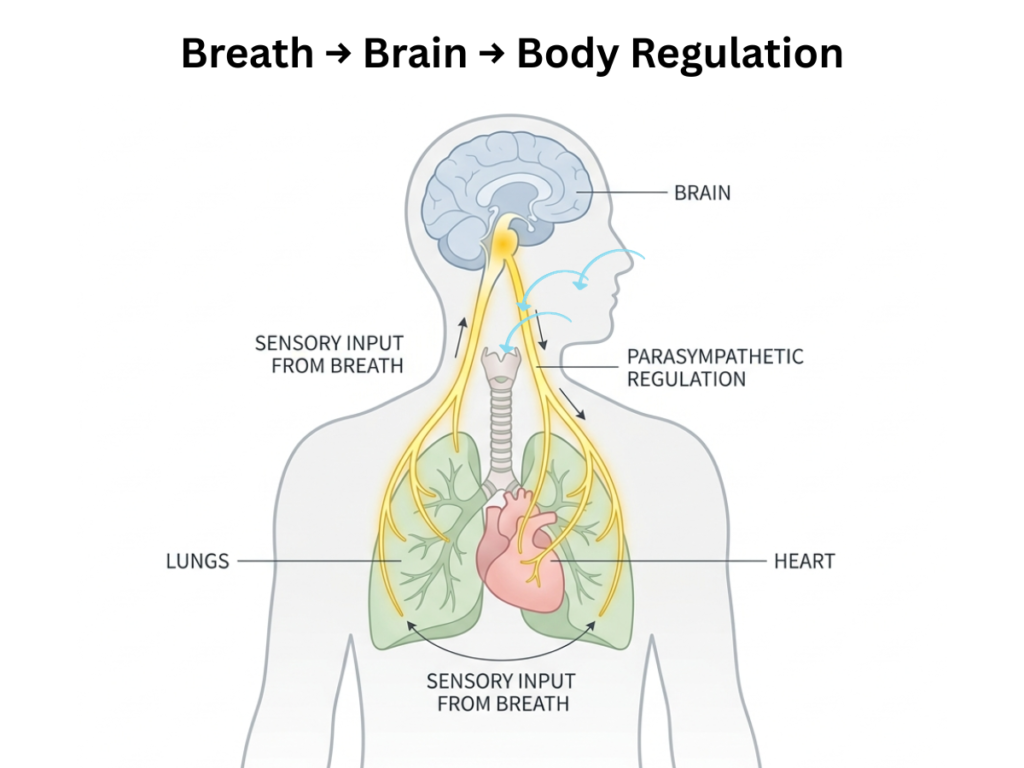
Observe how your breathing changes across different situations before attempting to modify it.
Position Within the Framework
Within the Mind-Body Blueprints system, breathing is not treated as a standalone practice. It is one of several inputs that influence regulation through identifiable physiological pathways.
As breathing can operate both automatically and voluntarily, it provides a rare interface between conscious behavior and unconscious biological regulation.
This article focuses on how breathing functions as a controllable input within the broader sequence:
Regulation → Observation → Stabilization → Refinement
Breathing is introduced at the level of regulation, but its value emerges only when it is observed across time and interpreted alongside other inputs such as movement and sleep.
Its role is not to produce immediate change.
It is to provide a repeatable signal that allows the system to become more predictable and interpretable.
This article focuses on breathing as one input within a broader regulatory system.
If you have not read the Foundations article, it provides the underlying structure for how regulation, observation, and behavioral change are approached within this framework.
Why Breathing Matters
Breathing operates in two modes:
- automatic (regulated by the brainstem)
- voluntary (modifiable through conscious control)
This dual control makes it a direct interface between conscious behavior and autonomic regulation.
Changes in breathing pattern can influence:
- internal chemistry (oxygen and carbon dioxide balance)
- neural signaling within the brainstem
- autonomic nervous system activity
Most of these changes occur without conscious awareness.
This makes breathing both: a signal of internal state and a mechanism that can influence that state.
For example:
Rapid breathing may reduce carbon dioxide levels in the blood, which can lead to:
- increased muscle tension
- reduced blood flow to the brain
- sensations of anxiety or agitation
Slower breathing tends to stabilize carbon dioxide levels and may support more balanced autonomic activity.
These changes do not guarantee calmness or improved focus.
They simply alter the physiological conditions under which these states occur.
Before Technique: Observation
Most breathing practices begin with instructions.
Within this system, they begin with observation.
Before modifying breathing patterns, it is useful to observe how breathing currently behaves.
Notice:
- breathing occurs through the nose or mouth
- movement occurs mainly in the chest or abdomen
- breathing pauses during concentration
- breathing becomes rapid during stress
These patterns often develop unconsciously and may persist for years without awareness.
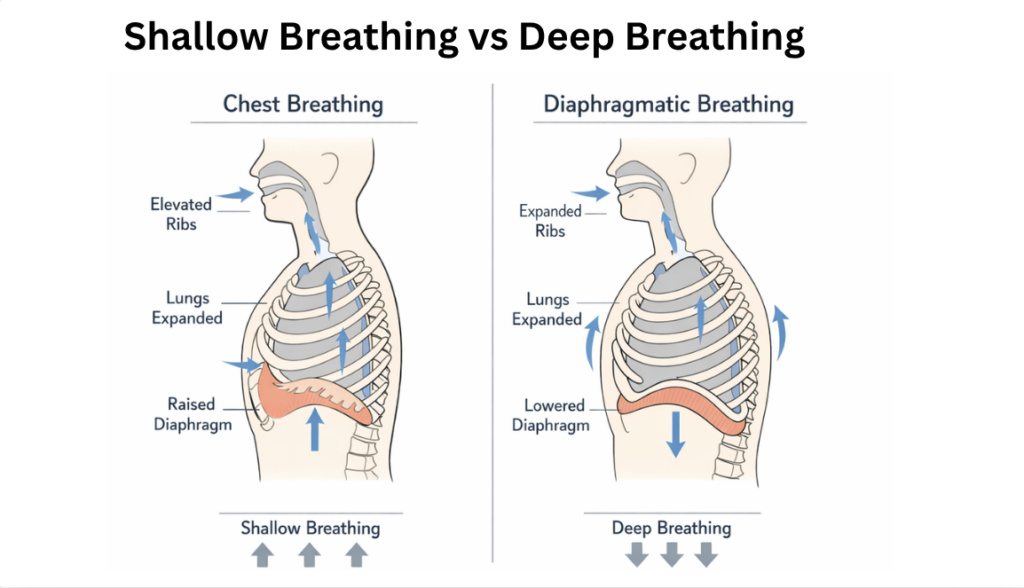
Before trying to fix anything, observe this first.
Download the 14-day observation tracker and simply record where your breath is coming from.
This phase is diagnostic. Observation establishes the baseline against which all changes are interpreted.
Without baseline observation, it becomes difficult to determine whether a breathing pattern is useful or simply adding effort.
The Biological Basis of Breathing Regulation
Breathing influences regulation through several interconnected systems.
Understanding these systems helps clarify why breathing patterns can influence internal state.
The Autonomic Nervous System
The autonomic nervous system regulates functions that operate without conscious control, including:
- heart rate
- digestion
- breathing
It operates through two interacting modes:
Sympathetic activity
Associated with mobilization and energy expenditure.
Parasympathetic activity
Associated with recovery, digestion, and restoration.
These systems constantly adjust based on signals from the body and environment.
Breathing patterns influence this balance by altering neural and chemical signals reaching the brainstem.
The Brainstem and Respiratory Rhythm
Breathing rhythm is generated in the brainstem by specialized neural networks.
One of these networks is known as the pre-Bötzinger complex, which acts as a biological rhythm generator for respiration. This system maintains breathing automatically.
When breathing patterns are consciously altered, the brainstem temporarily adjusts its rhythm in response.
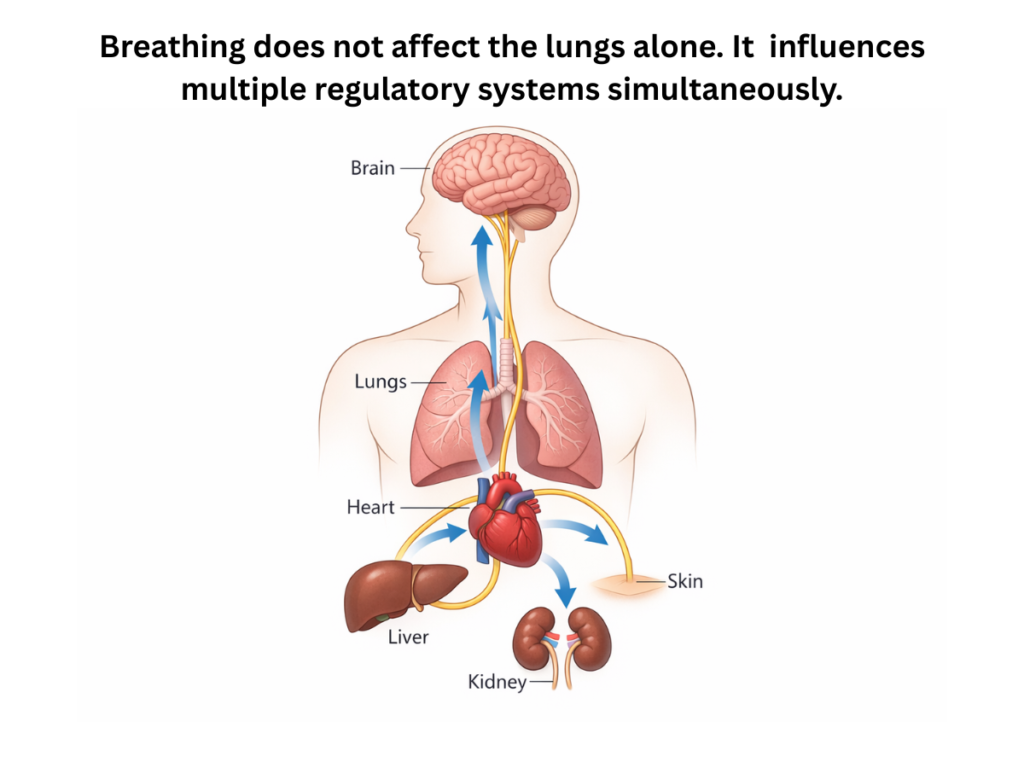
Because the brainstem also regulates cardiovascular and autonomic functions, these adjustments can influence multiple systems simultaneously.
Chemoreceptors and Carbon Dioxide Regulation
A common misconception is that breathing is primarily driven by oxygen demand.
In reality, breathing is mainly regulated by carbon dioxide (CO₂) levels in the blood.
Specialized sensors called chemoreceptors monitor:
- CO₂ levels
- blood pH
- oxygen levels
When CO₂ rises, the urge to breathe increases.
If breathing becomes too rapid or excessive, CO₂ levels can drop below optimal levels.
Low CO₂ can cause:
- blood vessel constriction
- reduced oxygen delivery to tissues
- sensations such as dizziness or anxiety
Slower breathing helps stabilize CO₂ levels and supports more efficient oxygen transport.
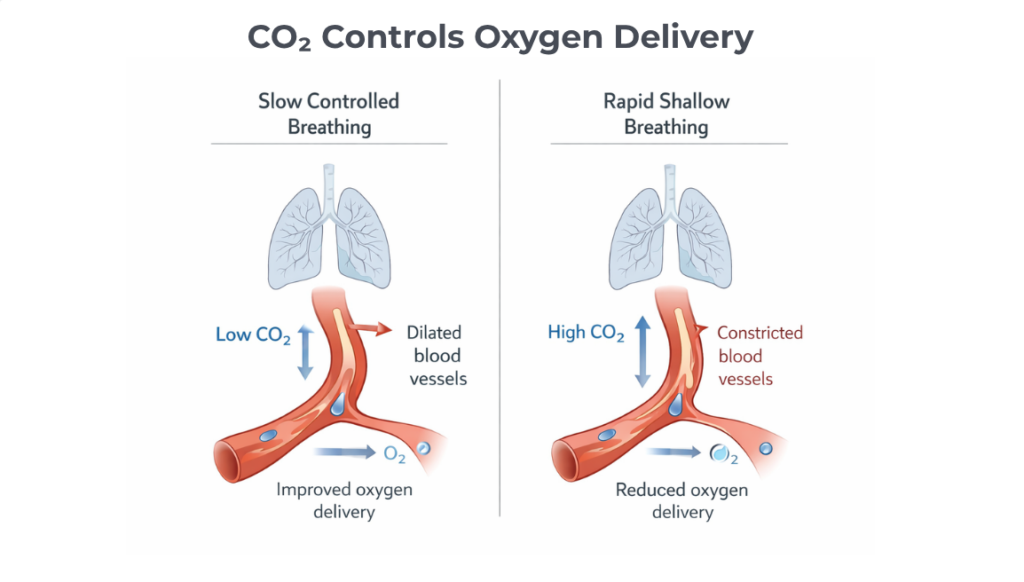
Don’t change your breathing yet.
First, notice when your breathing speeds up and what happens to your energy and focus.
.
The Vagus Nerve and Vagal Tone
The vagus nerve connects the brain to multiple organs, including the heart, lungs, and digestive system.
It is the primary pathway of the parasympathetic nervous system.
When parasympathetic activity increases, the body tends to shift toward recovery-oriented processes such as:
- slower heart rate
- improved digestion
- reduced physiological arousal
Vagal tone refers to the baseline strength and flexibility of this regulatory system.
Higher vagal tone is associated with:
- faster recovery from stress
- greater heart rate variability
- improved emotional regulation
Breathing patterns, particularly those involving longer exhalation, are associated with increased vagal activity.
Vagal Activity vs Vagal Tone
It is useful to distinguish between two related concepts.
Vagal activity
Short-term changes in parasympathetic signaling during a breathing pattern.
Vagal tone
Long-term regulatory capacity of the vagal system.
A single breathing session may increase vagal activity temporarily.
Consistent breathing patterns practiced over time may contribute to gradual changes in vagal tone.
This distinction explains why short-term experiences vary while long-term adaptation depends on repetition.
Mechanisms Through Which Breathing Influences Regulation
Breathing affects regulation through three overlapping mechanisms.
Chemical
Changes in CO₂ and oxygen levels in the blood.
Mechanical
Movement of the diaphragm and pressure changes in the chest cavity.
Neural
Signals transmitted through the vagus nerve and brainstem networks.
These mechanisms operate simultaneously and interact continuously.
At this point, it becomes clear that breathing does not operate in isolation.
These mechanisms interact with other inputs such as sleep, movement, and environmental conditions.
The Foundations article explains how these inputs are organized into a coherent system rather than treated separately.
MBB Tip: Detecting Unconscious Breath Holding
During focused work or screen use, pause briefly and observe your breathing.
Many people unconsciously hold their breath while concentrating.
This pattern may increase internal tension and disrupt breathing rhythm.
Resume gentle nasal breathing without exaggeration.
Observe:
- muscle tension decreases
- whether or not breathing becomes smoother
- if attention stabilizes
This exercise is not intended to correct breathing.
It helps reveal patterns that often occur unnoticed.
Regulation Before Optimization
Breathing practices are often promoted as quick solutions.
Within the Mind-Body Blueprints framework, breathing is approached differently.
Breathing is treated as a repeatable regulatory input rather than a performance technique.
Effective breathing patterns typically share three characteristics:
- low effort
- repeatability
- minimal disruption to natural breathing
Forceful breathing can increase tension and reduce sustainability.
The goal is stable influence, not dramatic change.
Foundational Breathing Patterns
Each pattern is an input to observe, not a technique to perfect.
The following patterns illustrate different ways breathing can influence physiological regulation.
Extended Exhalation Breathing (1:2 Ratio)
Pattern:
Inhale for approximately 3–4 seconds.
Exhale for approximately 6–8 seconds.
[Image: Breathing Waveform (1:2 Ratio)]
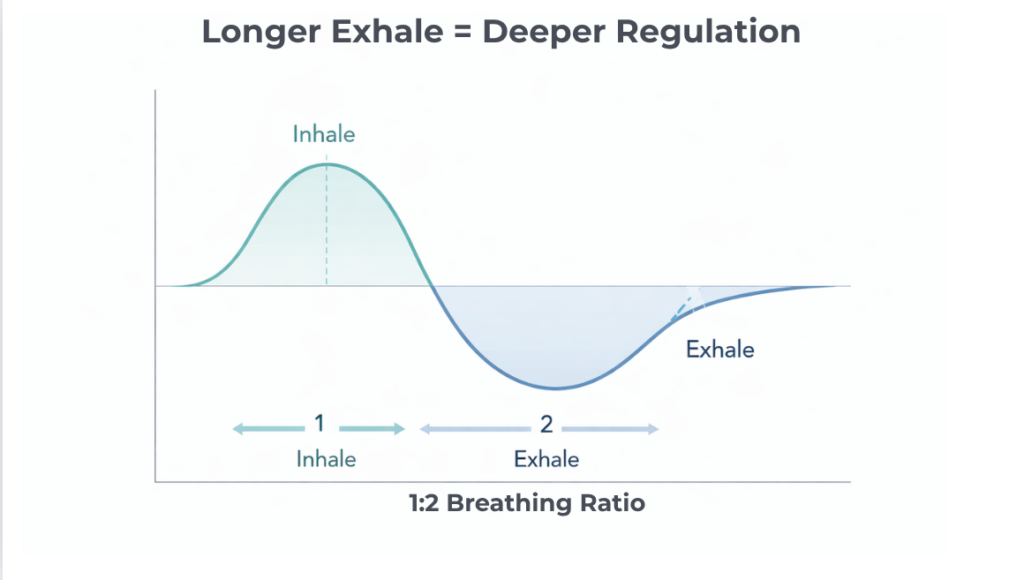
Now test this pattern deliberately.
Use the tracker to compare how your system responds before and after slower breathing.
Mechanism:
Longer exhalation is associated with increased parasympathetic signaling through vagal pathways.
Possible Effects:
- reduced physiological tension
- slower internal pacing
- improved sense of control
Observation:
Notice whether breathing feels effortless and whether mental pacing changes.
Resonant Breathing
Pattern:
Inhale for about 5–6 seconds.
Exhale for about 5–6 seconds.
Mechanism:
This breathing rate aligns with the body’s baroreflex, a regulatory system involved in blood pressure and heart rhythm control.
Possible Effects:
- smoother physiological rhythms
- increased heart rate variability
Observation:
Notice whether breathing rhythm becomes easier to maintain over time.
Cyclic Sigh
Pattern:
Two short inhales followed by one longer exhale.
Mechanism:
Rapid changes in lung volume and CO₂ balance may reduce acute physiological arousal.
Possible Effects:
- short-term reduction in stress intensity
Observation:
Notice whether the effect appears quickly and whether repeated use produces diminishing returns.
Box Breathing
Pattern:
Equal inhale, hold, exhale, hold.
Mechanism:
Brief breath holds slightly increase CO₂ levels, which may improve tolerance to internal sensations.
Possible Effects:
- improved attentional stability
- reduced reactivity
Observation:
Notice whether breath holds feel comfortable or strained.
MBB Tip: The Extended Exhale Adjustment
During periods of rising mental or emotional intensity, slightly lengthen the exhalation without forcing the inhalation.
Inhale naturally through the nose.
Allow the exhale to extend a few seconds longer than usual.
This pattern may increase parasympathetic signaling and slow heart rate dynamics.
Observe:
- whether breathing remains comfortable
- whether mental pacing changes
- whether the effect persists after several cycles
If breathing begins to feel forced, shorten the exhale.
When Downregulation Feels Uncomfortable
For some individuals, slowing breathing initially produces discomfort.
This response is sometimes described as relaxation-induced anxiety.
It may occur when the nervous system is accustomed to higher levels of activation.
In such cases:
- reduce duration
- avoid forced breathing
- introduce shorter breathing intervals
Discomfort does not indicate failure.
It provides information about the system’s current sensitivity.
Interpreting Effects
Breathing practices should not be evaluated based on a single session.
More useful indicators include:
- repeatability across days
- reduction in variability
- faster recovery after stress
This shifts attention from immediate results to observable patterns over time.
BREATHING PROTOCOL
Breathing Observation and Stabilization Protocol (5 Days)
This is not a performance routine.
It is a short observational phase designed to help you understand how breathing interacts with your internal state under normal conditions.
The objective is not to change breathing immediately, but to identify patterns that already exist.
Days 1–2: Baseline Observation
No structured breathing practice is introduced during this phase.
The goal is to observe how breathing behaves without interference.
Pay attention to:
- whether breathing is nasal or oral
- whether movement occurs in the chest or abdomen
- changes in breathing during stress, focus, or screen use
- any tendency toward breath holding
Observe briefly at different times of the day rather than continuously.
Avoid:
- attempting to correct breathing
- forcing slower or deeper breaths
- over-monitoring, which can alter natural patterns
Interpretation:
You are not looking for “good” or “bad” breathing.
You are identifying patterns and variability.
Days 3–4: Introduce a Single Input
Add one structured input:
- 2–5 minutes of extended exhalation breathing (1:2 ratio), once daily
Keep all other variables unchanged.
Pay attention to:
- whether breathing feels effortless or forced
- changes in mental pacing
- subtle shifts in tension or restlessness
- whether effects persist after the session
Avoid:
- increasing duration too quickly
- combining multiple breathing techniques
- trying to achieve a specific feeling
Interpretation:
The goal is not immediate change.
The goal is to observe how one controlled input interacts with your system.
Day 5: Contextual Application
Apply the same breathing pattern in a real situation:
- during mild stress
- or during a transition (before work, before sleep)
Pay attention to:
- how quickly the pattern can be applied
- whether the effect is consistent or variable
- whether it feels supportive or effortful
Avoid:
- using breathing as a “fix”
- forcing the pattern under high stress
- expecting uniform results
Interpretation:
You are testing whether the input is adaptable, not whether it is universally effective.
How to Use This Protocol
- keep duration short
- observe at consistent times where possible
- record simple observations (1–2 lines is enough)
Missed days are still useful information.
What This Phase Reveals
By the end of 5 days, you should begin to notice:
- baseline breathing patterns
- sensitivity to changes in breathing
- which patterns feel sustainable
This creates the foundation for more structured use later.
From Observation to System
Breathing patterns become more meaningful when they are not evaluated in isolation.
Over multiple days, interactions begin to emerge:
• how sleep influences breathing stability
• how movement affects breathing rhythm
• how stress alters breathing patterns
At this stage, breathing is no longer just an input.
It becomes part of a pattern network within the system.
To observe these interactions, use the Mind-Body Blueprints Regulation & Observation Tracker.
The tracker allows breathing to be interpreted alongside other variables rather than in isolation, which significantly improves clarity.
The breathing, movement, and sleep guides function as the interpretation layer for this process.
Integration Into the Framework
Breathing integrates into the Mind-Body Blueprints framework as a progressive input:
Regulation
Introduce simple, low-effort breathing patterns that do not disrupt natural rhythm
Observation
Track how breathing changes across contexts such as stress, focus, and rest
Stabilization
Retain patterns that reduce variability and feel sustainable across days
Refinement
Adjust timing, duration, and context based on observed responses
Breathing is not optimized in isolation.
It is adjusted in relation to other inputs such as sleep and movement.
This interaction determines whether breathing functions as a stabilizing input or remains situational.
Within the broader system, breathing rarely operates as the primary limiting factor.
In many cases, instability in breathing reflects upstream influences such as:
• inconsistent sleep
• prolonged inactivity
• sustained cognitive load
This is why breathing is interpreted alongside other inputs rather than adjusted in isolation.
The goal is not to fix breathing directly.
It is to understand what is influencing it.
Understanding breathing in isolation is only the first step.
Within the Mind-Body Blueprints framework, meaningful change emerges from how multiple inputs interact over time.
The Foundations article outlines this structure, including how breathing, movement, sleep, and observation are integrated into a single system.
Closing Perspective
Breathing is often presented as a technique for producing immediate change.
Within this system, it is treated differently.
It functions as:
• a signal of current state
• a controllable input
• a feedback mechanism within a larger regulatory system
When used without observation, breathing becomes another routine.
When used with observation, it becomes a method for understanding how the system responds under different conditions.
The objective is not to control the system directly.
The objective is to make its behavior more predictable and interpretable over time.
Stability does not emerge from intensity.
It emerges when small inputs produce consistent, observable effects.
Breathing is one of the simplest entry points into that process.
Its value is not in what it does immediately, but in what it reveals when observed consistently.
Disclaimer
The information provided in this article is intended for educational and informational purposes only and should not be considered medical advice, diagnosis, or treatment.
Mind-Body Blueprints explores the relationship between the brain, nervous system, behavior, and physiology through an evidence-informed lens. While the concepts, strategies, and practices discussed may support general health, recovery, and self-regulation, they are not a substitute for professional medical care.
Individual responses can vary based on age, health status, medications, lifestyle, and other factors. Always consult a qualified healthcare professional before making significant changes to your sleep habits, exercise routine, nutrition, medication use, or health management plan, particularly if you have an existing medical condition or are under clinical care.
The views expressed in this article are intended to support understanding and informed decision-making, not to replace personalized medical guidance.
By reading this content, you acknowledge that responsibility for health-related decisions remains with you and your healthcare providers.
References & Further Reading
These references focus on underlying physiological and neural mechanisms rather than specific techniques, consistent with the system-based approach of this article.
- Feldman, J.L., Del Negro, C.A., & Gray, P.A. (2013). “Understanding the Rhythm of Breathing: So Near, Yet So Far.” Annual Review of Physiology. Read the full study: https://doi.org/10.1146/annurev-physiol-040510-130049
- Del Negro, C.A., Funk, G.D., & Feldman, J.L. (2018). “Breathing Matters.” Nature Reviews Neuroscience. Read the full study: https://www.researchgate.net/publication/325027842_Breathing_matters
- Nattie, E., & Li, A. (2012). “Central Chemoreceptors: Locations and Functions.” Comprehensive Physiology.
Access article: https://doi.org/10.1002/cphy.c100083 - West, J.B. (2012). Respiratory Physiology: The Essentials. Lippincott Williams & Wilkins.
Access resource: https://shop.lww.com/Respiratory-Physiology–The-Essentials/p/9781451119459 - Russo, M.A., Santarelli, D.M., & O’Rourke, D. (2017). “The Physiological Effects of Slow Breathing in the Healthy Human.” Breathe Journal. Read the full study: https://doi.org/10.1183/20734735.009817
- Shaffer, F., & Ginsberg, J.P. (2017). “An Overview of Heart Rate Variability Metrics and Norms.” Frontiers in Public Health. Read the full study: https://doi.org/10.3389/fpubh.2017.00258
- Lehrer, P.M., & Gevirtz, R. (2014). “Heart Rate Variability Biofeedback: How and Why Does It Work?” Frontiers in Psychology. Read the full study: https://doi.org/10.3389/fpsyg.2014.00756
- Porges, S.W. (2007). “The Polyvagal Perspective.” Biological Psychology. Access article :https://doi.org/10.1016/j.biopsycho.2006.06.009
- Zaccaro, A., Piarulli, A., Laurino, M., et al. (2018). “How Breath-Control Can Change Your Life: A Systematic Review. ”Frontiers in Human Neuroscience.
Read the full study: https://doi.org/10.3389/fnhum.2018.00353 - Benarroch, E.E. (1993). “The Central Autonomic Network: Functional Organization and Perspective.” Mayo Clinic Proceedings. Access article: https://doi.org/10.1016/S0025-6196(12)62272-1