
Sleep Regulation: How Sleep Shapes Recovery, Energy, and Performance
Word Count: 5610 | Reading Time: 30 minutes | Last Updated: 23 June, 2026

Why Sleep Determines System Stability
Sleep regulation is the biological process that coordinates sleep timing, sleep pressure, recovery, and nervous system function. Through these interconnected processes, sleep influences energy production, emotional stability, cognitive performance, stress resilience, and long-term health.
Many people believe they have an energy problem, a motivation problem, a focus problem, or a stress problem. In many cases, however, they have a recovery problem.
When energy becomes inconsistent, concentration begins to fluctuate, emotional reactions become more intense, and everyday demands start to feel disproportionately difficult. Most people attempt to solve these challenges during the day through caffeine, productivity systems, motivation strategies, or increased effort. These approaches often assume the underlying system is functioning correctly and simply requires better management.
That assumption is often incomplete.
Sleep is not merely a period of inactivity between productive hours. It is one of the primary biological processes that determines whether the nervous system can recover, regulate itself, and maintain stability under changing conditions.
When sleep becomes inconsistent, the effects extend far beyond tiredness. Attention often becomes more fragmented because the brain struggles to filter and organize incoming information efficiently. Emotional responses may become more reactive as stress-regulation systems lose flexibility. Stress tolerance decreases, making ordinary demands feel disproportionately overwhelming.
Over time, many individuals also notice a growing disconnect between mental intent and physical execution. Routine tasks begin to feel heavier, slower, or less coordinated despite adequate effort.
These experiences are often interpreted as personal shortcomings such as lack of discipline, poor motivation, or reduced willpower. In many cases, however, the issue is simpler: the system itself has not recovered properly.
Sleep does not just influence how you feel.
It determines how reliably your system functions.
IN THIS ARTICLE
- Sleep as a Regulatory Foundation
- Why Sleep Is Not Passive Rest
- Sleep Architecture and Biological Mechanisms
- Circadian Rhythm and Sleep Pressure
- The Glymphatic System
- Sleep and Emotional Regulation
- Sleep Regularity and Pattern Interpretation
- Common Misconceptions About Sleep
- Regulation Before Optimization
- From Understanding to Application
- Integration Into the Framework
- Final Perspective: Stability Before Optimization
WHY SLEEP REGULATION MATTERS IN DAILY LIFE
When sleep becomes unstable, the effects rarely remain isolated to nighttime fatigue.
Most people experience the consequences indirectly through changes in mood, cognition, energy, and behavior during the day. Attention becomes harder to sustain during conversations or focused work. Small stressors begin to feel disproportionately intense. Motivation fluctuates more sharply. Afternoon energy crashes become more common, often leading to increased reliance on caffeine or stimulation.
Many people interpret these experiences separately as low motivation, irritability, poor concentration, or inconsistent productivity. In reality, unstable sleep may be influencing all of them simultaneously.
This is one reason sleep disruption is often underestimated. The disruption itself occurs during the night, but the consequences appear across multiple systems during the day. By the time emotional instability, cognitive fatigue, or energy variability become noticeable, the underlying recovery process has already been affected.
Sleep therefore functions less like a single health behavior and more like a foundational regulatory process that shapes how the nervous system performs under everyday conditions.
| MBB INTERPRETATION |
| Sleep disruption rarely affects a single system in isolation. Cognitive instability, emotional reactivity, reduced recovery, and energy variability often emerge simultaneously because the underlying recovery process itself has become unstable. |
POSITION WITHIN THE FRAMEWORK
Within Mind-Body Blueprints, sleep is not treated as an isolated lifestyle habit. It functions as a foundational regulatory process that supports emotional regulation, cognitive stability, physiological recovery, and adaptive nervous system function.
This systems-oriented perspective is explored more broadly in The Mind-Body Connection: The Blueprint Behind How Your Brain Shapes Your Biology, the foundational article of the Mind-Body Blueprints framework. It explains how the nervous system, hormones, metabolism, immune function, behavior, and environmental inputs interact to shape biological regulation. Sleep is one of the most influential components of that larger regulatory network.
Sleep supports regulation by reducing accumulated physiological load and helping recalibrate hormonal and nervous system activity over time.
Stable sleep also supports stabilization by reducing day-to-day variability across mood, energy, cognitive performance, and emotional responsiveness. Finally, it supports refinement because more advanced physical or cognitive optimization becomes meaningful only once the baseline system itself is functioning predictably.
Without stable sleep, interpretation becomes unreliable because the signals produced by the system are inconsistent.
SLEEP IS NOT PASSIVE REST
Sleep is often described as rest, but biologically it is highly active.
During sleep, the brain and body shift away from external interaction and toward internal restoration. Neural networks reorganize and recalibrate. Memories are consolidated into long-term storage. Emotional experiences are processed and integrated. Hormonal rhythms reset. Immune signaling adjusts. Metabolic repair processes increase. Waste products accumulated during waking activity are cleared from brain tissue through large-scale maintenance processes associated with deep sleep1.
This means sleep is not simply a pause in activity. It is a transition from outward engagement toward inward maintenance and recalibration.
A useful distinction is this:
Wakefulness is optimized for interaction.
Sleep is optimized for restoration and system maintenance.
Because these processes occur outside conscious awareness, sleep is often underestimated. People usually notice sleep only when its absence begins affecting daytime function. By that stage, the disruption has already influenced multiple systems simultaneously.
This is why insufficient sleep rarely appears as “just tiredness.” It often presents as cognitive instability, emotional reactivity, reduced stress tolerance, slower recovery, inconsistent motivation, and increased physiological strain.
The body can temporarily compensate for poor sleep through stress hormones and stimulation, but compensation is not the same as recovery. Over time, unresolved recovery debt accumulates as instability across multiple systems.
SLEEP ARCHITECTURE AND SLEEP REGULATION
Recovery during sleep is organized rather than uniform. Throughout the night, the nervous system moves through distinct stages that contribute differently to restoration, learning, emotional processing, and physiological maintenance.
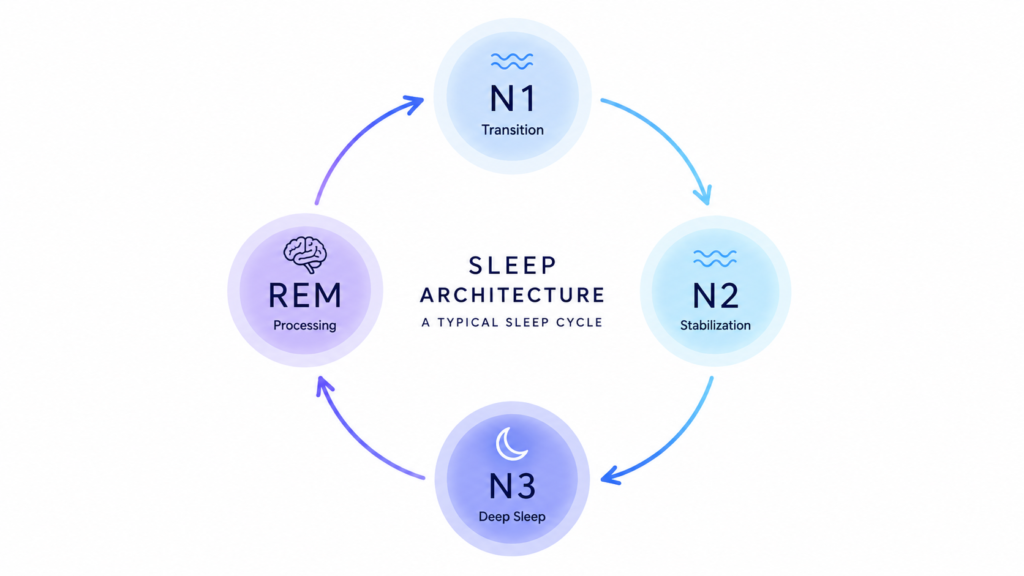
The Internal Recalibration Process
Sleep is not a single continuous state. It unfolds in repeating cycles throughout the night, with each stage supporting a different aspect of restoration and nervous system regulation.
Stage N1: The Transition Phase
N1 represents the transition from wakefulness into sleep. Awareness of the external environment gradually decreases, muscle activity begins to relax, and the nervous system starts disengaging from active interaction.
Although brief, this stage is important because it initiates the shift away from externally oriented processing and toward internal restoration.
Stage N2: The Stabilization Phase
During N2 sleep, heart rate slows, body temperature decreases, and brain activity becomes more structured. This stage occupies the largest portion of the night and acts as a stabilizing buffer between lighter sleep and deeper restoration.
The nervous system progressively reduces responsiveness to external stimulation, allowing recovery processes to deepen more consistently.
Stage N3: Deep Sleep and Physical Restoration
N3, often referred to as deep sleep, is the most physically restorative stage of the night. During this phase, growth hormone release increases, tissue repair processes accelerate, immune activity strengthens, and large-scale restoration processes become more active.
This stage also appears to support more efficient neurological waste clearance and metabolic recovery.
REM Sleep: Integration and Processing
REM sleep is associated with memory consolidation, emotional processing, learning integration, and cognitive recalibration. ⁷ During this stage, the brain becomes highly active while the body remains largely immobile.
Rather than functioning as passive rest, REM sleep appears to play an important role in integrating emotional experiences and organizing information accumulated during wakefulness.
Sleep quality therefore depends on more than duration alone. It depends on how effectively the nervous system moves through these stages throughout the night.
While the stages of sleep repeat throughout the night, they do not occur in equal proportions. Deep sleep is typically concentrated during the first half of the night, while REM sleep gradually expands toward morning.
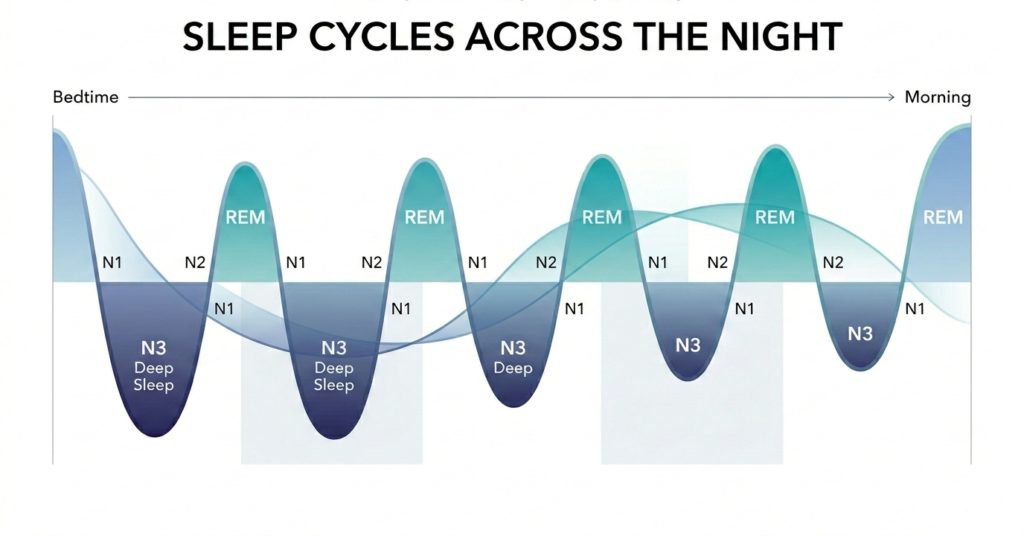
You cannot directly control sleep stages. You can only influence the conditions that allow them to occur more consistently.
“The quality of daytime regulation is often influenced by processes that occurred the night before.”
FROM SLEEP ARCHITECTURE TO BIOLOGICAL MECHANISMS
Understanding the stages of sleep explains what happens throughout the night. Understanding the biological mechanisms of sleep explains why those stages occur and how the nervous system regulates them.
Sleep is not controlled by a single switch in the brain. It emerges from the interaction between multiple systems that regulate timing, physiological drive, hormonal signaling, neural restoration, and environmental responsiveness.
The most important of these systems are circadian rhythm and sleep pressure. Together, they help determine when the body feels awake, when it becomes sleepy, and how effectively it transitions into restorative sleep.
THE BIOLOGICAL MECHANISMS OF SLEEP
CIRCADIAN RHYTHM AND SLEEP REGULATION
The Body’s Internal Timing System
The circadian rhythm is the body’s internal timing system. It is regulated by a small region in the brain called the suprachiasmatic nucleus (SCN), which functions as the body’s central biological clock.
The SCN receives information about light exposure directly from the eyes and uses that information to coordinate timing signals throughout the body. These signals influence sleep and wake timing, hormone release, body temperature, alertness levels, digestion, and metabolic activity.
Morning light plays a particularly important role. When natural light enters the eyes early in the day, the SCN signals the body to increase alertness and suppress melatonin production. As evening light decreases, melatonin production gradually rises, body temperature begins to decline, and the nervous system shifts toward sleep readiness. ⁶
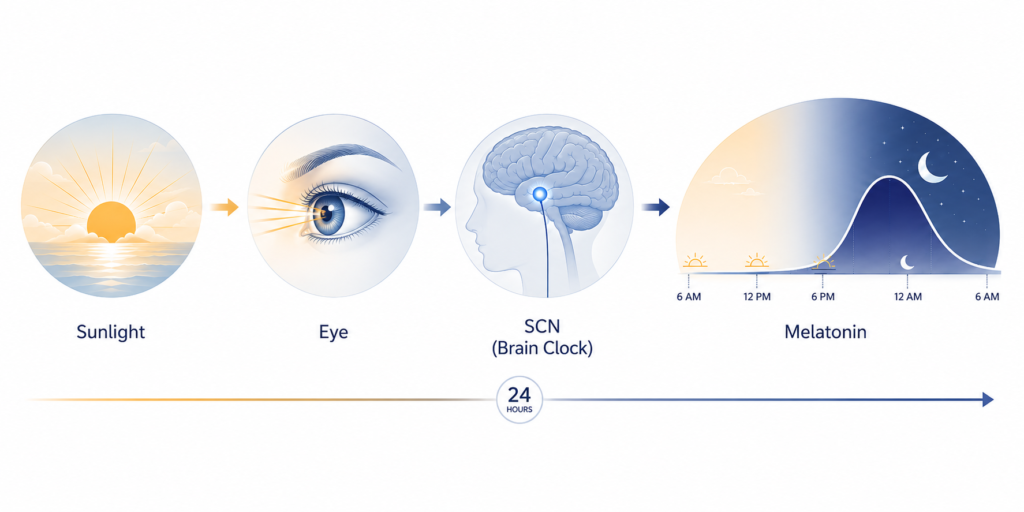
The body’s internal clock uses environmental light signals to coordinate daily rhythms in alertness, hormone release, metabolism, and sleep readiness.
Circadian rhythm therefore does not simply determine when you sleep. It determines how prepared the body is to enter sleep efficiently.
When light exposure becomes inconsistent, the timing system becomes unstable. This often leads to delayed sleep onset, irregular energy levels, and reduced recovery quality.
SLEEP PRESSURE AND SLEEP REGULATION
The Biological Drive to Sleep
While circadian rhythm helps determine when the body is prepared for sleep, sleep pressure determines how strongly the body wants to sleep.
Sleep pressure is a biological drive that gradually builds throughout the day as the brain and body remain active. One of the primary contributors to this process is adenosine, a naturally occurring molecule that accumulates during wakefulness as cellular activity continues².
As adenosine levels increase, the drive for sleep becomes progressively stronger. This growing pressure helps shift the nervous system toward recovery by increasing feelings of tiredness and reducing the capacity to sustain prolonged wakefulness. During sleep, adenosine levels gradually decline, allowing the system to reset before the next day begins.
Several factors can influence this process. Caffeine temporarily blocks adenosine receptors, reducing the perception of sleepiness without eliminating the underlying need for recovery. Irregular wake times may disrupt the predictable accumulation of sleep pressure, while long or poorly timed daytime naps can partially reduce the pressure that would otherwise support nighttime sleep.
This helps explain a common experience: feeling exhausted physically while remaining mentally alert and unable to fall asleep. In many cases, the issue is not a lack of fatigue, but a mismatch between the biological systems that regulate sleep.
Healthy sleep emerges when circadian rhythm and sleep pressure work together. Circadian rhythm provides the timing signal that prepares the body for sleep, while sleep pressure provides the biological drive that makes sleep possible. When these systems are aligned, the transition into sleep becomes more efficient. When they become misaligned, recovery often becomes less predictable and sleep quality may decline.
Together, these mechanisms explain when and why sleep occurs. However, sleep supports recovery through more than timing and physiological drive alone. Once sleep begins, a series of internal maintenance and restoration processes become active within the brain itself.
THE GLYMPHATIC SYSTEM
Neurological Waste Clearance
Neural activity generates metabolic by-products continuously throughout the day. As information is processed, signals are transmitted, and energy is consumed, the brain must continually manage the accumulation of cellular waste products. Glymphatic activity appears to increase during sleep, particularly during deeper stages of sleep, supporting large-scale maintenance processes within the brain.
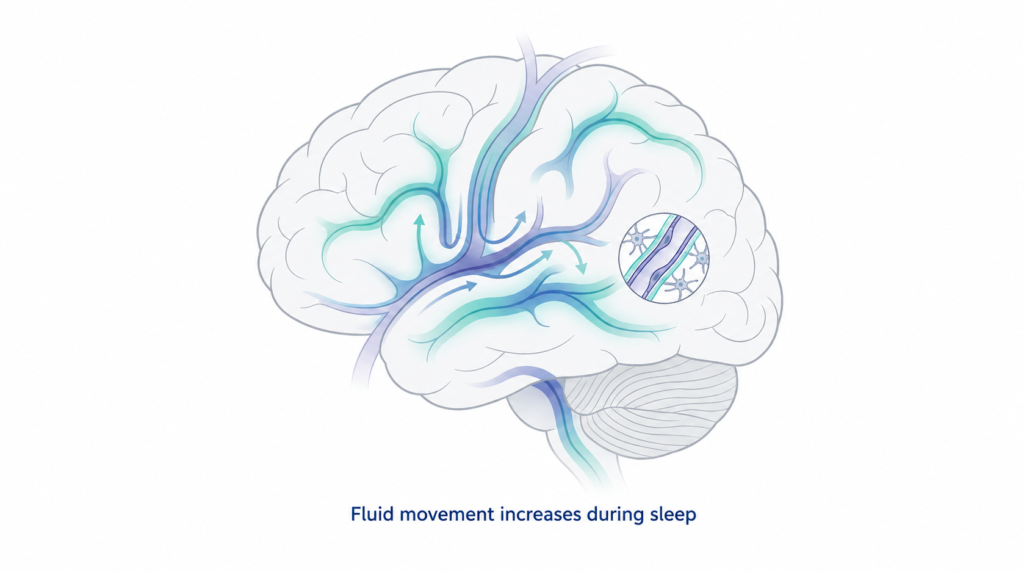
While the popular idea of “detoxifying the brain” often oversimplifies the science, evidence suggests that sleep plays an important role in maintaining the environment in which healthy neural function occurs.
Research suggests that during deep sleep, the spaces between brain cells expand, allowing cerebrospinal fluid to circulate more efficiently through brain tissue. This process may support the removal of compounds such as beta-amyloid and tau proteins, which are associated with long-term neurological health¹.
Emerging evidence also suggests that sleep position may influence glymphatic efficiency, with side-sleeping potentially supporting more effective fluid movement compared to other positions. While this area of research is still developing, it reinforces the broader idea that sleep functions as an active maintenance process rather than passive inactivity.
This does not mean sleep is a “detox hack.” However, it does suggest that chronic sleep disruption may reduce the efficiency of long-term neurological restoration.
What many individuals describe as “brain fog” may partly reflect incomplete recovery and reduced neural efficiency following insufficient or inconsistent sleep.
HORMONAL, METABOLIC AND IMMUNE REGULATION
Sleep influences multiple biological systems simultaneously. It helps regulate cortisol, the body’s primary stress hormone, while also supporting melatonin production and metabolic stability. Sleep also affects insulin sensitivity and appetite regulation, which explains why poor sleep often increases hunger, cravings, and energy instability.
At the same time, sleep plays a major role in immune signaling and inflammation regulation. Chronic sleep disruption has been associated with increased inflammatory activity and reduced physiological resilience⁴. This is one reason prolonged poor sleep often produces the feeling of being physically “run down.”
Sleep influences recovery at multiple levels simultaneously. While hormonal, metabolic, and immune systems are recalibrated during sleep, the nervous system is also processing emotional information and adjusting how it responds to future stressors. This is one reason the effects of poor sleep often appear first in mood, patience, and emotional flexibility before individuals recognize sleep itself as the underlying variable.
SLEEP REGULATION AND EMOTIONAL STABILITY
Sleep does not influence physical recovery alone. It also affects how the nervous system interprets and responds to emotional and environmental stressors throughout the day.
When sleep becomes insufficient or irregular, emotional systems often become more reactive while regulatory systems become less flexible. Research suggests that sleep disruption increases amygdala reactivity while reducing prefrontal regulation, making ordinary stressors feel more intense and more difficult to manage⁸.
This creates a common misunderstanding:
“I need better emotional control.”
Many people attempt to solve this problem through willpower. However, regulation becomes significantly more difficult when the underlying recovery systems themselves are compromised.
In many cases, emotional reactivity reflects reduced recovery capacity rather than a lack of willpower or resilience. The underlying issue is often physiological instability.
This is one reason poor sleep frequently appears as irritability, emotional sensitivity, reduced patience, or disproportionate stress responses long before individuals consciously identify sleep itself as the underlying issue.
Stable sleep therefore supports more than energy restoration. It also helps maintain emotional adaptability and nervous system flexibility under everyday conditions.
SLEEP REGULARITY AND DURATION
Why Consistency Matters More Than Perfection
Traditional sleep advice focused heavily on duration, particularly the idea of achieving “8 hours” of sleep every night.
Recent research increasingly highlights the importance of sleep regularity. One emerging metric, known as the Sleep Regularity Index (SRI), measures how consistently a person is asleep or awake at similar times each day3.
This matters because the body relies heavily on prediction. Consistent sleep timing helps synchronize biological rhythms across multiple systems, including metabolism, hormone release, digestion, energy regulation, and cognitive performance.
An irregular 9-hour sleep schedule may therefore produce less stable recovery than a consistent 7-hour schedule.
Sleep consistency also appears to influence coordination between cognitive processing, physical responsiveness, and perceived mental clarity. When sleep becomes fragmented or irregular, many individuals report feeling mentally slower, physically heavier, or less coordinated during everyday tasks.
“Consistency allows prediction. Prediction supports regulation.”
Duration Matters Too
Sleep duration remains important even though consistency often receives less attention.
Most healthy adults require approximately seven to nine hours of sleep per night, although individual variation exists. Some individuals naturally function near the lower end of this range, while others require more recovery time to maintain cognitive performance, emotional stability, and physiological resilience.
Duration should not be viewed in isolation. Seven and a half hours of consistent, restorative sleep may support recovery more effectively than a longer but highly fragmented schedule. At the same time, chronic restriction below individual sleep need is associated with reduced cognitive performance, impaired emotional regulation, slower recovery, and increased physiological strain.
The objective is therefore not a rigid target. It is sufficient recovery combined with regularity, stability, and predictable sleep timing.
| KEY INTERPRETATION |
| Most people attempt to improve sleep by changing what happens during the final hour before bed. In reality, sleep quality is often influenced by what occurs throughout the entire day, including light exposure, movement patterns, stress load, stimulation, and wake-time consistency. |
COMMON MISCONCEPTIONS ABOUT SLEEP
Many people believe they need exactly eight hours of sleep every night. In reality, sleep requirements vary between individuals, and consistency often matters more than rigid duration targets alone.
Another common misconception is that falling asleep extremely quickly is always a positive sign. In some cases, very rapid sleep onset may actually reflect accumulated sleep debt and insufficient recovery over time.
Alcohol is also frequently misunderstood. Although it may increase sedation and shorten sleep onset temporarily, it disrupts sleep architecture and REM sleep, often reducing overall recovery quality⁵. Sedation is therefore not the same as restoration.
Many people also assume supplements can “fix” sleep directly. In reality, supplements may alter symptoms or temporarily influence sleepiness without addressing the underlying instability affecting recovery itself.
Rigid sleep routines can create similar problems. Excessive monitoring, pressure, and hyper-focus on achieving “perfect sleep” may increase cognitive activation rather than reduce it.
Sleep regulation depends less on perfect control and more on creating conditions that support predictable recovery over time.
ADVANCED SLEEP PATTERN INTERPRETATION
Sleep patterns often provide more useful information than isolated symptoms.
Difficulty falling asleep is frequently linked to delayed circadian timing, excessive evening stimulation, or inconsistent schedules. The common “tired but wired” pattern usually reflects elevated physiological arousal, where the body is fatigued but the nervous system remains activated due to stress or overstimulation.
Frequent nighttime awakenings are often associated with environmental disruption, stress signaling, alcohol use, or fragmented sleep architecture. Adequate sleep duration combined with poor recovery usually points toward issues with sleep quality, circadian alignment, or chronic stress load rather than insufficient time in bed.
Another increasingly common pattern is social jet lag, where sleep schedules differ dramatically between weekdays and weekends. This repeatedly disrupts circadian timing, creating a form of chronic biological inconsistency.
Patterns matter more than isolated symptoms because different patterns require different adjustments.
BEFORE INTERVENTION: OBSERVATION FIRST
When sleep feels disrupted, most people immediately search for solutions. They add supplements, introduce rigid routines, or attempt to “force” better sleep through effort and optimization.
This often creates more confusion because intervention begins before patterns are understood.
Instead, begin with observation.
Spend several days observing sleep timing, wake timing, nighttime awakenings, morning energy, and fluctuations in daytime alertness and recovery. The goal is not detailed perfectionistic tracking, but gradual recognition of how recovery patterns shift across multiple days.
The objective at this stage is not immediate improvement. It is understanding.
Sleep is naturally variable. A single poor night rarely means much. Repeated patterns, however, provide valuable information about how the system is functioning.
Observation also reduces the tendency to overreact to isolated nights of poor sleep. It prevents unnecessary interventions from being introduced before the underlying pattern is understood.
The goal is not obsessive monitoring. The goal is recognizing how timing, stimulation, stress, and recovery interact across multiple days.
DECISION FRAMEWORK
When to Observe, Stabilize, Adjust, or Escalate
Not every sleep issue requires immediate intervention. Overcorrection often increases instability by creating pressure and excessive monitoring.
Short periods of poor sleep or occasional variability generally require observation rather than action. Mild inconsistency usually responds best to stabilization through fixed wake times, consistent light exposure, and reduced variability in daily scheduling.
More persistent issues, such as repeated difficulty falling asleep or frequent nighttime awakenings, may require targeted adjustments. At this stage, changes should be introduced one variable at a time so that cause-and-effect relationships remain clear.
Chronic insomnia, severe fatigue despite adequate sleep opportunity, or persistent dysfunction may require broader evaluation beyond behavioral adjustments alone.
The correct response depends on pattern and persistence, not urgency.
REGULATION BEFORE OPTIMIZATION
Modern sleep culture often encourages people to optimize recovery before stabilizing the basic conditions that regulate it.
Many individuals introduce:
- supplements
- trackers
- advanced routines
- highly specific sleep targets
- restrictive behavioral systems
while foundational variables such as timing consistency, light exposure, stress load, and environmental predictability remain unstable.
In some cases, this increases monitoring and performance pressure without meaningfully improving recovery quality.
Sleep is unusual because it does not respond well to excessive control. Most biological and performance processes improve through effort, precision, and direct intervention. Sleep often improves indirectly, through reduction of instability and improvement of conditions.
This is one reason excessive optimization sometimes becomes counterproductive. Constant sleep tracking, over-analysis, rigid routines, and pressure to achieve “perfect sleep” may increase physiological and cognitive activation rather than reduce it.
| MBB INTERPRETATION |
| Sleep often improves not when more interventions are added, but when unnecessary physiological and cognitive activation is gradually reduced. |
For this reason, stabilization should precede optimization.
Most meaningful improvement comes from relatively simple variables:
- consistent timing
- reduced day-to-day variability
- lower evening stimulation
- improved circadian predictability
- gradual nervous system downregulation
Optimization strategies may become useful later, but they are rarely the starting point.
FROM UNDERSTANDING TO APPLICATION
Understanding sleep mechanisms is important, but understanding alone does not automatically improve recovery.
Sleep regulation depends on more than isolated nighttime interventions. Recovery quality is influenced by circadian timing, nervous system activation, environmental stimulation, behavioral variability, stress physiology, and recovery consistency across multiple days.
For many individuals, meaningful improvement begins not through aggressive optimization, but through gradual stabilization and clearer observation of how the system responds to timing, stimulation, and recovery conditions.
This process often involves improving circadian predictability, reducing excessive physiological and cognitive activation, identifying patterns of instability, reducing unnecessary variability, and supporting more consistent nervous system downregulation over time.
The goal is to improve the conditions that support consistent recovery and more stable sleep over time.
THE SLEEP REGULATION AND STABILIZATION BLUEPRINT
The concepts discussed throughout this article become far more useful when they are applied systematically.
The Sleep Regulation and Stabilization Blueprint is a practical companion designed to help you identify patterns, improve recovery consistency, strengthen circadian stability, and support long-term nervous system regulation.
Inside the blueprint you will learn how to:
- identify sources of sleep instability
- improve sleep timing consistency
- strengthen circadian alignment
- reduce excessive physiological and cognitive activation
- develop a personalized recovery-supportive environment
- track meaningful sleep patterns without becoming overly dependent on data
The objective is not perfect sleep. The objective is more predictable recovery, improved regulation, and greater long-term stability.
SLEEP FRAGMENTATION IN MODERN ENVIRONMENTS
Human sleep evolved under conditions of darkness, predictable environmental cues, and clear transitions between activity and recovery. Modern environments often compress these boundaries, extending stimulation far beyond the periods for which biological timing systems originally evolved.
Many modern environments are poorly aligned with the biological conditions that historically supported sleep. Artificial lighting extends wakefulness well beyond sunset, digital devices provide continuous stimulation, and work-related communication often blurs the boundary between activity and recovery.
Notifications, streaming platforms, social media engagement, irregular work schedules, and prolonged screen exposure can all increase cognitive activation late into the evening. These influences do not guarantee poor sleep, but they may reduce the predictability of the transition from wakefulness into recovery.
These environmental pressures help explain why sleep difficulties have become increasingly common. In many cases, the challenge is not a lack of effort, but a growing mismatch between modern patterns of stimulation and the biological systems that regulate recovery.
Certain environmental conditions may either support or interfere with the transition from wakefulness into recovery.
SUPPORTING NERVOUS SYSTEM DOWNREGULATION
Reducing Residual Activation Before Sleep
For many individuals, difficulty sleeping is not caused by insufficient fatigue alone. The body may feel physically tired while the nervous system remains physiologically or cognitively activated.
Modern environments continuously expose the brain and body to stimulation through:
- artificial light
- prolonged screen exposure
- cognitive overload
- emotional stress
- environmental unpredictability
- irregular schedules
As a result, the transition from active engagement into recovery may become less gradual and more difficult for the nervous system to navigate consistently.
This is one reason sleep quality often depends less on exhaustion itself and more on the ability to reduce residual activation before recovery.
DOWNREGULATION
Downregulation refers to the gradual reduction of physiological, cognitive, and environmental stimulation that helps the nervous system shift away from active alertness and toward recovery-oriented processes.
For some individuals, relatively simple adjustments may help support this transition:
- reducing excessive evening light exposure
- lowering cognitive stimulation late in the evening
- reducing environmental unpredictability
- practicing slower breathing patterns
- reducing residual muscular tension
- externalizing repetitive thoughts or unfinished tasks before sleep
These approaches should not be viewed as techniques for producing sleep on demand. Their purpose is to reduce unnecessary activation and support a smoother transition toward recovery-oriented states
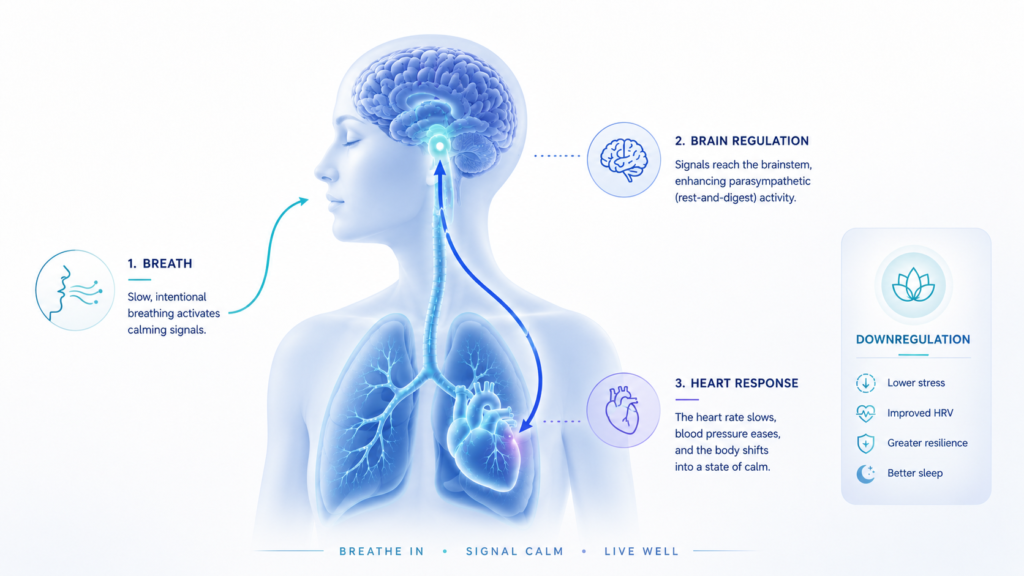
Slow, intentional breathing provides regulatory signals that influence the brain and heart, helping the nervous system transition from activation toward recovery.Breathing patterns are closely connected to autonomic nervous system activity and may influence how the body transitions between states of alertness and recovery. Rapid and shallow breathing patterns are commonly associated with increased physiological activation, while slower and more controlled breathing may help support nervous system downregulation.
This relationship is explored more deeply in Breathing as a Regulatory Input, which examines how breathing functions not only as a respiratory process, but also as a regulatory input capable of influencing stress physiology, emotional regulation, and recovery states.
Different individuals respond differently to different approaches. In many cases, the goal is not to build a perfect nighttime routine, but to identify which conditions help the nervous system disengage more consistently from persistent activation.
Sleep often improves not when more interventions are added, but when unnecessary stimulation is gradually removed.
Breathing represents one of the fastest ways to influence nervous system state. Slow, controlled breathing may help reduce physiological activation and support the transition from alertness toward recovery-oriented states. If you would like to explore the science and practical application of breathing in greater depth, see BREATHING AS A REGULATORY INPUT, where we examine how breathing influences autonomic regulation, stress physiology, emotional stability, and recovery.
THE SLEEP EFFORT PARADOX
The paradox is that sleep emerges most reliably when the nervous system perceives sufficient safety to disengage from monitoring. Effort, pressure, and constant evaluation can unintentionally signal the opposite. When attention becomes excessively focused on whether sleep is occurring, physiological and cognitive activation may remain elevated, making recovery more difficult rather than easier
Sleep is one of the few biological processes that cannot be forced directly.
Most skills improve through increased effort and concentration. Sleep often behaves differently. Excessive monitoring, pressure, and attempts to “make sleep happen” may increase physiological activation and interfere with recovery itself.
In many cases, the harder someone tries to sleep, the more difficult sleep may become.
Sleep therefore depends less on effort and more on conditions that support nervous system disengagement and reduced activation.
| MBB INTERPRETATION |
| The nervous system disengages more effectively under conditions of reduced monitoring, reduced pressure, and reduced threat perception. |
“Recovery cannot be forced, but the conditions that support recovery can be cultivated.”
INTEGRATION INTO THE FRAMEWORK
Sleep does not operate independently. It interacts continuously with breathing patterns, movement behavior, stress physiology, emotional regulation, and recovery capacity.
Poor breathing habits may increase nighttime arousal and sympathetic activation. Insufficient movement may reduce healthy sleep pressure accumulation during the day. Chronic stress may disrupt both circadian timing and emotional regulation simultaneously.
Breathing patterns may influence physiological arousal and autonomic regulation, while movement behavior helps regulate circadian rhythm, metabolic stability, and recovery pressure throughout the day.
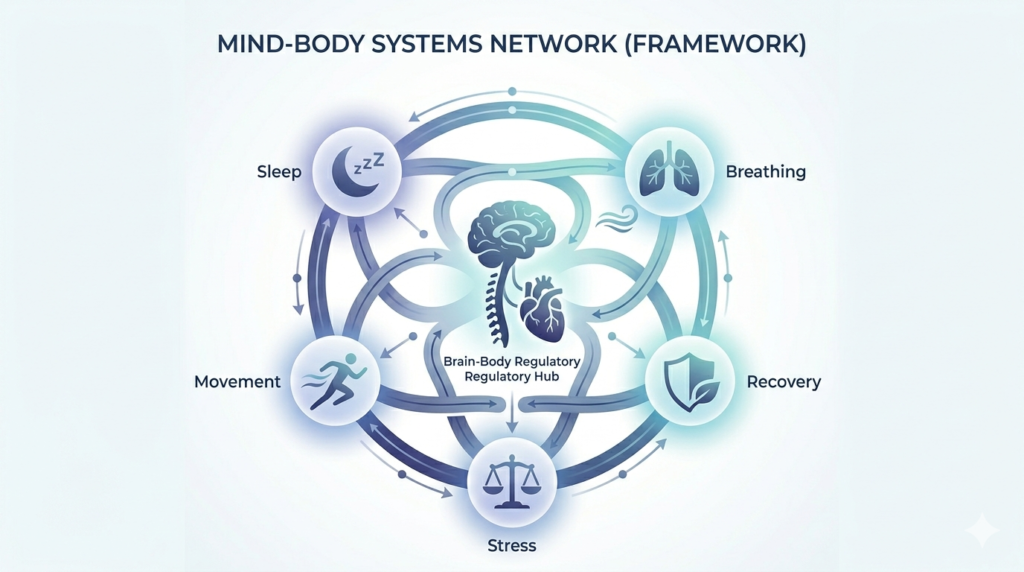
These relationships are explored further in:
- Breathing as a Regulatory Input
- Movement as a Regulatory Input (coming soon)
- Stress Regulation and Nervous System Stability (coming soon)
Stress physiology interacts continuously with sleep, breathing, movement, and recovery. Elevated stress signaling may influence circadian timing, emotional regulation, sleep quality, and physiological recovery simultaneously, making it one of the central variables within the broader regulatory network.
These systems continuously influence one another rather than functioning separately. Tracking them together often provides clearer insight into overall nervous system stability than observing any single variable in isolation.
Within Mind-Body Blueprints, sleep is therefore not viewed as a standalone habit. It functions as part of a larger regulatory network that shapes how the nervous system adapts, recovers, and maintains stability under changing conditions.
Understanding sleep in isolation is useful. Understanding how sleep interacts with breathing, movement, stress physiology, and recovery creates a more complete picture of regulation.
FINAL PERSPECTIVE
Predictability Over Perfection
Sleep is one of the foundational recovery processes that supports adaptation, regulation, and long-term nervous system stability.
Modern sleep culture often encourages people to pursue perfect recovery through increasing control, optimization, and constant monitoring. In practice, meaningful improvement usually emerges more gradually through consistency, reduced variability, and improved regulation over time.
Biological systems are inherently dynamic. Occasional disruption is normal. The objective is therefore not perfect sleep every night, but more predictable and reliable recovery across time.
When sleep stabilizes, improvements often become visible across multiple domains, including energy regulation, emotional flexibility, cognitive performance, and stress resilience.
Reliable recovery also changes how the body responds to uncertainty, adaptation, physical strain, emotional stress, and daily cognitive demand. Sleep therefore serves as a biological stabilizer that supports resilience across multiple systems simultaneously.
Recovery is not built in a single night. It develops gradually through repeated conditions that support stability, predictability, and reduced physiological overload over time.
Within the broader Mind-Body Blueprints framework, sleep functions as one component of a larger regulatory network. Breathing, movement, stress regulation, recovery capacity, and sleep continuously influence one another. Strengthening any single domain can support the others, but stable sleep remains one of the most powerful foundations upon which broader regulation is built.
Understanding the system is the first step. Stabilizing the system is what allows adaptation, resilience, and long-term optimization to emerge.
Sleep Is a Signal, Not a Problem to Solve
Better sleep rarely begins by trying harder to sleep. It begins by creating the biological conditions that allow sleep to emerge naturally. Observation comes before optimization. Regulation comes before refinement. The goal is not perfect sleep. The goal is a more stable and adaptable system over time.
Download the Sleep Regulation and Stabilization Blueprint to begin applying these principles in a structured way.
DISCLAIMER
The information provided in this article is intended for educational and informational purposes only and should not be considered medical advice, diagnosis, or treatment.
Mind-Body Blueprints explores the relationship between the brain, nervous system, behavior, and physiology through an evidence-informed lens. While the concepts, strategies, and practices discussed may support general health, recovery, and self-regulation, they are not a substitute for professional medical care.
Individual responses can vary based on age, health status, medications, lifestyle, and other factors. Always consult a qualified healthcare professional before making significant changes to your sleep habits, exercise routine, nutrition, medication use, or health management plan, particularly if you have an existing medical condition or are under clinical care.
The views expressed in this article are intended to support understanding and informed decision-making, not to replace personalized medical guidance.
By reading this content, you acknowledge that responsibility for health-related decisions remains with you and your healthcare providers.
REFERENCES AND FURTHER READING
- Xie L, Kang H, Xu Q, et al. “Sleep Drives Metabolite Clearance from the Adult Brain.” Science. 2013;342(6156):373–377.
https://www.science.org/doi/10.1126/science.1241224 - Borbély AA. “A Two Process Model of Sleep Regulation.” Human Neurobiology. 1982;1(3):195–204.
https://pubmed.ncbi.nlm.nih.gov/7185792/ - Phillips AJK, Clerx WM, O’Brien CS, et al. “Irregular Sleep/Wake Patterns Are Associated With Poorer Academic Performance and Delayed Circadian and Sleep/Wake Timing.” Scientific Reports. 2017;7:3216.
https://www.nature.com/articles/s41598-017-03171-4 - Irwin MR. “Sleep and Inflammation: Partners in Sickness and in Health.” Nature Reviews Immunology. 2019;19(11):702–715.
https://www.nature.com/articles/s41577-019-0190-z - Walker MP. Why We Sleep: Unlocking the Power of Sleep and Dreams. Scribner; 2017.
https://www.simonandschuster.com/books/Why-We-Sleep/Matthew-Walker/9781501144325 - Panda S. The Circadian Code. Rodale Books; 2018.
https://www.satchinpanda.com/the-circadian-code/ - Rasch B, Born J. “About Sleep’s Role in Memory.” Physiological Reviews. 2013;93(2):681–766.
https://journals.physiology.org/doi/full/10.1152/physrev.00032.2012 - Krause AJ, Simon EB, Mander BA, et al. “The Sleep-Deprived Human Brain.” Nature Reviews Neuroscience. 2017;18(7):404–418.
https://www.nature.com/articles/nrn.2017.55 - Sleep Foundation. “Sleep Stages and Sleep Cycles.” Available from: Sleep Foundation.
https://www.sleepfoundation.org/stages-of-sleep - National Institute of Neurological Disorders and Stroke. “Brain Basics: Understanding Sleep.” Available from: NINDS Sleep Resources.
https://www.ninds.nih.gov/health-information/public-education/brain-basics/brain-basics-understanding-sleep
About the Author
Pankaj Bhargava, M.Sc. (Life Sciences) is the founder of Mind-Body Blueprints, a science-based platform focused on understanding how brain regulation influences health, recovery, resilience, and performance. His work translates complex biological systems into practical frameworks that help readers build more stable and adaptive health behaviors.